REVIEW · SAN FRANCISCO
City Sightseeing San Francisco Hop-On Hop-Off Bus Tour
Book on Viator →Operated by City Sightseeing Ltd - USA and Middle East · Bookable on Viator
Hop buses make getting bearings effortless. I like the live English guide and the hop-on hop-off flexibility that lets you move at your pace, from Union Square to Fisherman’s Wharf and out toward Golden Gate Park. You’re not stuck with one timeline; you can ride, hop off for photos, and catch the next bus when it works for you.
I also appreciate the practical tech touches: free Wi-Fi onboard and an audio guide app with commentary in 13 languages. That means you can switch between the live guide’s spoken updates and your own audio track when you want more detail.
One thing to weigh before you book: if you’re sensitive to loud onboard audio or need extra help getting on and off with a mobility aid, the ride may feel tricky. A recent rider described loud music and difficulty using a walker, so I’d plan with comfort in mind.
In This Review
- Key things to know before you ride
- San Francisco in Two Hours: why this loop works
- Timing and frequency: riding smart between 10:15 and 17:30
- Stop 1: Union Square to Powell-Hyde views (Geary & Powell)
- Stop 2: Chinatown near Bush & Grant (Tian Xia Wei Gong)
- Stop 3: Financial District by 773 Kearny (Hilton area)
- Stop 4: North Beach with a quick hop at Cali
- Stops 5 and 6: Pier 35 (1914) and the Pier 39 walk
- Stop 7 and 8: Fisherman’s Wharf and Ghirardelli Square
- Stop 9: Fort Mason by Van Ness & North Point
- Stop 10: Lombard Street area (Van Ness & Lombard)
- Stop 11: Palace of Fine Arts (and the Museum vibe)
- Stop 12: Golden Gate Bridge viewpoint from the US-101 off-ramp
- Stops 13 to 15: Golden Gate Park hits, from Japanese Tea Garden to Cal Academy
- Stop 16: Haight-Ashbury at Haight St & Clayton St
- Stop 17: Alamo Square at Divisadero & Hayes
- Stop 18: Civic Center near Larkin & McAllister
- Live guide, audio app, and onboard Wi‑Fi: how to get more meaning from the ride
- Value check: when this hop-on hop-off bus is a smart buy
- Should you book this City Sightseeing San Francisco bus?
- FAQ
- How long is the City Sightseeing San Francisco hop-on hop-off bus tour?
- How often do the buses depart?
- Where are the first and last departures, and what times are they?
- Is there a live guide and is it in English?
- Do I need to bring headphones for the audio guide app?
- Does the bus stop right next to Pier 39?
Key things to know before you ride
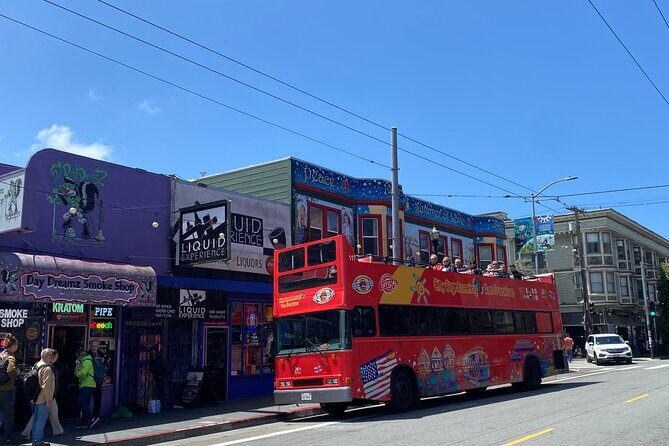
- Live English guide on every bus for real-time pointers and route context
- Audio guide app in 13 languages (bring your own smartphone and earphones)
- Free Wi-Fi onboard, helpful for mapping stops and messaging the group
- Pier 39 is not right at the stop; hop off at Pier 35 and walk about 100 metres
- A 2-hour loop with frequent buses every 40 minutes, so you can time hops without stress
- Coverage of big-name areas from Chinatown and North Beach to Golden Gate Park and Haight-Ashbury
San Francisco in Two Hours: why this loop works
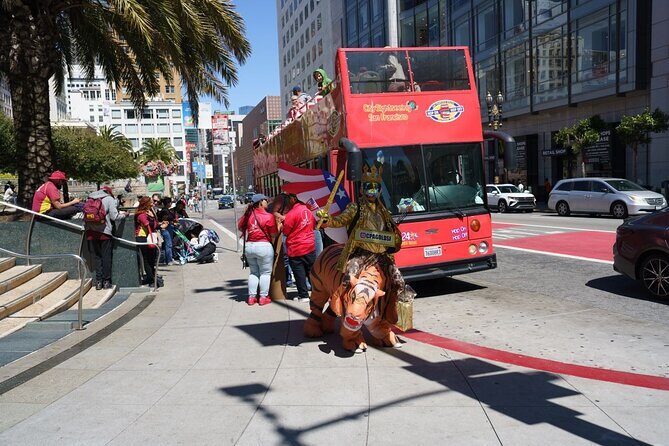
This is a great format if you want speed plus choice. San Francisco is laid out in layers: downtown grid, then hills, then seaside, then big parklands. A hop-on hop-off bus stitches those layers together quickly, so you spend less time figuring out where things are and more time deciding what to explore next.
The most useful part for me is the way the route is built around recognition. You hit classic anchors like Union Square, Chinatown, North Beach, Fisherman’s Wharf, Golden Gate Bridge viewpoints, Golden Gate Park, and Haight-Ashbury. Even if you don’t hop off everywhere, you’re still seeing the city’s main “mental map.”
Also, the stop spacing is intentional. Many of the stops are tied to landmarks or well-known intersections, not vague pull-offs. That matters because it reduces the guesswork when you step off to grab a photo or walk a short distance to something specific.
You can also read our reviews of more city tours in San Francisco


Timing and frequency: riding smart between 10:15 and 17:30
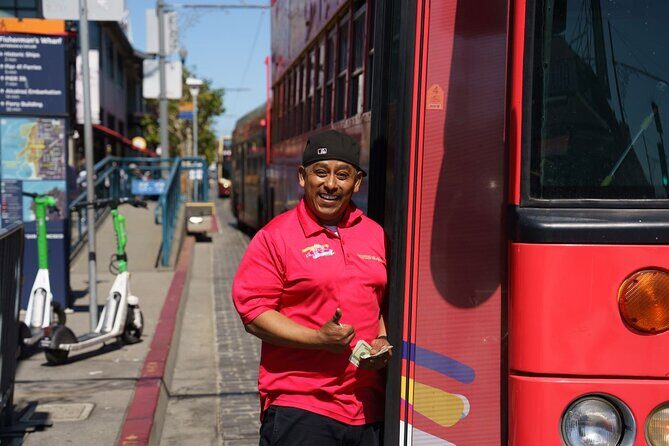
The first departure is at 10:15am from Stop 1, and the last departure is at 5:30pm, also from Stop 1. The loop is listed at about 2 hours, and buses run about every 40 minutes.
That frequency is a big deal. It means you don’t have to sprint between stops. If you hop off at a park entrance, a museum area, or a hilltop viewpoint and take longer than planned, you’re likely not derailed—you can usually catch the next bus instead of waiting endlessly.
If you’re trying to “beat the lines” (especially around popular areas), I’d treat the bus as your moving platform. Ride through once to set your bearings, then pick one or two stops for a deeper walk. Trying to do everything from the bus can be exhausting. San Francisco hills will happily remind you of that.
Stop 1: Union Square to Powell-Hyde views (Geary & Powell)
Your starting point is in the Powell-Hyde area around Union Square, specifically Geary Street & Powell Street. This is a handy first stop because it’s central and easy to orient from. If this is your first time in town, starting here gives you a baseline for how the city transitions from downtown into the neighborhoods below and to the west.
When you’re onboard, I’d use this part of the route to identify the direction you’ll want later. You’ll also start stacking images in your head: downtown streets above, cable car territory nearby, and the sense that the city rises and drops fast.
Practical tip: if you’re planning to hop off early, do it near the downtown core first. It’s easier to do quick errands and meet up than it is once you’re farther out near the park and outer neighborhoods.
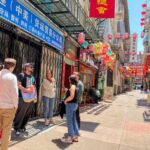
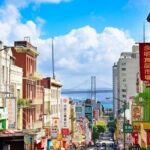
Stop 2: Chinatown near Bush & Grant (Tian Xia Wei Gong)
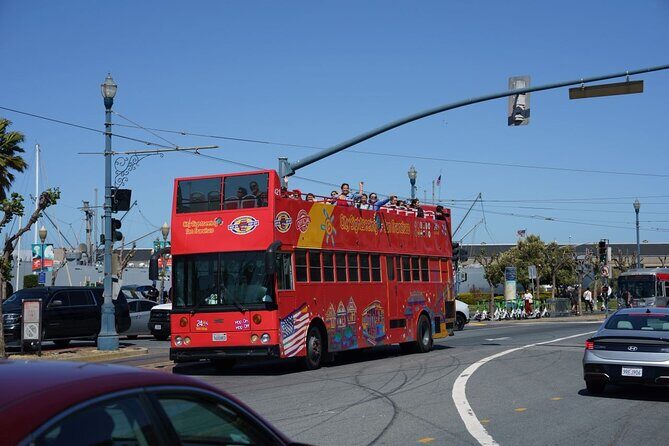
Next you head into Chinatown, around the Bush & Grant area. One stop listed is Tian Xia Wei Gong, which signals you’re not far from some of the district’s well-known streets and storefronts.
Chinatown on a bus tour is mostly about atmosphere and orientation. You’ll be able to see how the neighborhood sits in relation to downtown, and you can decide whether you want to do a short walk now or save it for later. If you hop off here, you’re close to the kind of side streets where you can lose 30 minutes without meaning to—which is often the point.
Drawback to keep in mind: Chinatown is dense, so it’s not ideal for a long bus-to-bus shuffle where you’re constantly re-boarding. Use the stop to choose a small area to explore, then go back to the bus when you’re done.
Stop 3: Financial District by 773 Kearny (Hilton area)
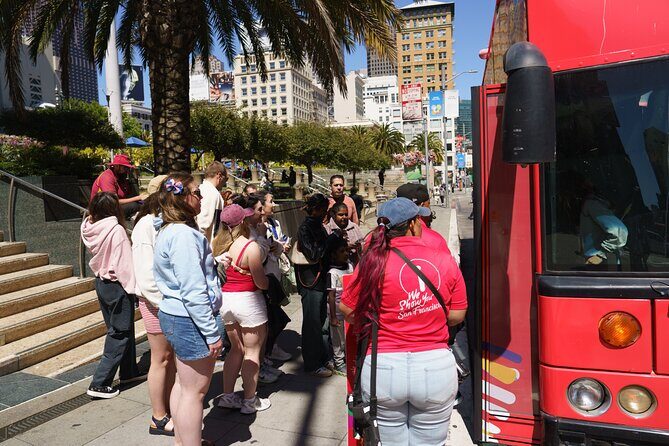
Your third stop is at 773 Kearny Street, near the Hilton Hotel. This segment is useful because it gives you the “business SF” contrast. You’ll see the clean lines of the Financial District before the route turns again toward older, more character-rich areas.
If you like architecture and city design, this is the section where you’ll likely pay extra attention. One rider noted enjoying architecture and murals as the bus rolled past—this kind of downtown stretch is exactly where those details show up in quick flashes between traffic lights.
If you’re hopping off here, keep the walk short. This is a neighborhood that works best when you’re purposeful and have a target, not when you’re wandering randomly—at least if you want to stay on schedule.



Stop 4: North Beach with a quick hop at Cali
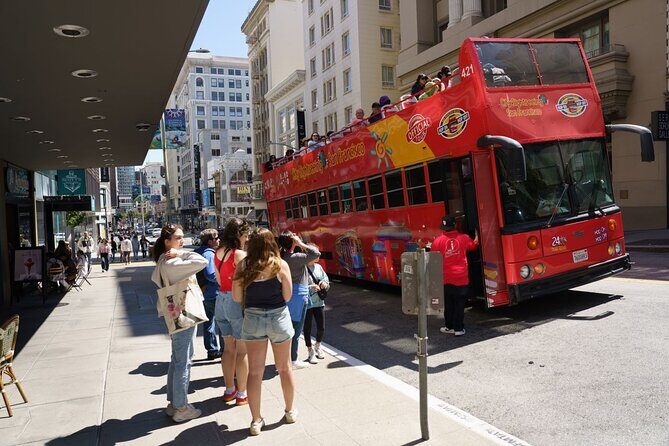
Then you swing into North Beach, with a listed stop at Cali. North Beach is the kind of place where you can feel the shift from corporate downtown to older streets and more pedestrian energy.
From the bus, you’ll get the layout and the vibes. If you hop off, you can turn it into a short neighborhood walk—coffee, viewpoints, or a quick stroll to reset your legs after the downtown blocks.
What I like about including North Beach is that it gives you a break from the heavier sightseeing zones. It’s a “small but meaningful” stop: enough time to sample, not so long that the rest of the day collapses.
Stops 5 and 6: Pier 35 (1914) and the Pier 39 walk
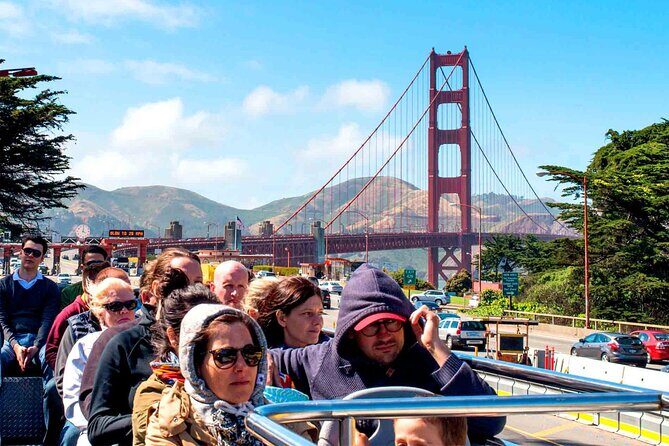
One of the most important details is the waterfront stop setup. Stop 5 is at 1440 The Embarcadero, Pier 35 (1914). Stop 6 is at Royal Caribbean Group at Pier 35, and here’s the key note: the buses do not stop right next to Pier 39.
For Pier 39, you need to hop off at Stop 6 and walk about 100 metres from Pier 35 to Pier 39. That’s a short walk, but it’s still a step you should plan for. Don’t assume you can step off and instantly be at Pier 39’s main entrance.
If the ocean air is your thing, this segment is a good time to hop off for photos and fresh views. If you’re doing it with kids or group members, set a simple meeting point before you step away; the pier area is easy to move around, but people tend to drift once they spot snacks and souvenir stops.
Stop 7 and 8: Fisherman’s Wharf and Ghirardelli Square
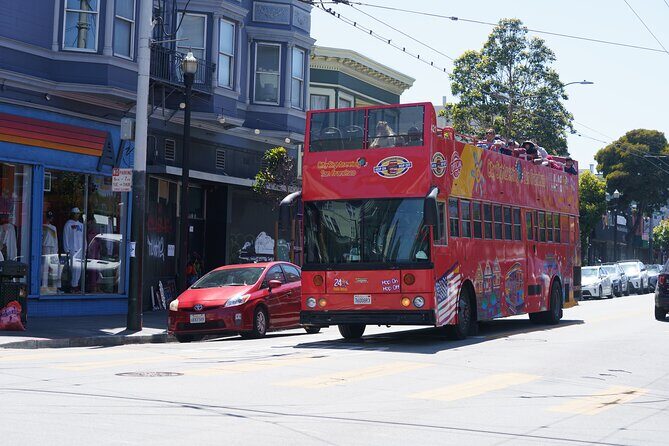
Fisherman’s Wharf is next, with a listed stop near a LibertyX Bitcoin ATM. That sounds oddly specific, but it’s helpful in practice. It gives you a real-world anchor when you’re trying to line up re-boarding or meet up.
Then you reach Tea Square at Ghirardelli Square. This is one of the easiest “quick hit” stops on the route because it’s recognizable and compact compared with the broader waterfront.
I’d use these two stops together like this: ride the bus to get your bearings, then choose one place to linger. Doing both plus every pier-side photo op can turn into a long detour. Save your energy for Golden Gate Park next.
Stop 9: Fort Mason by Van Ness & North Point
Now you’re heading toward Fort Mason, listed at Van Ness Ave & North Point St. This stop helps you understand the city’s relationship to the bay and the coastal corridors leading toward the Golden Gate area.
On a bus tour, the practical win is the viewpoint potential. You’re getting a sense of the waterfront geography without needing to drive or park. If you hop off briefly, look for angles where the city’s edges meet the water.
If you’re short on time, you might not even need to get off here. Staying onboard is still useful because it keeps you moving while you scan for what you want later.
Stop 10: Lombard Street area (Van Ness & Lombard)
You get a chance to catch Lombard Street near the Van Ness & Lombard intersection. This is one of those stops that makes the tour feel real fast. You’ll see how quickly the city shifts from flat street grids into hill-hugging lines and curves.
I’d hop off only if you’re actually planning to walk a bit. Lombard is a photo magnet, which means it can be crowded and slow. If crowds aren’t your thing, you can also take a look from the bus and decide later if it’s worth leaving the timeline.
Either way, this is a strong photo stop that helps you picture how SF’s hills shape daily life.
Stop 11: Palace of Fine Arts (and the Museum vibe)
Stop 11 is labeled as San Francisco Deluxe sightseeing Bus Tours (Palace-of-fine-Arts), placing you near the Palace of Fine Arts area. Even if you don’t go inside, the building and surrounding grounds read clearly from the bus and nearby streets.
Why I think this stop matters: it gives you variety. Downtown and waterfront are one type of scenery. Palace of Fine Arts is softer and more open, and it can reset your eyes before you go toward the larger park zones.
If you do hop off, keep it simple: quick photos, a short walk, and then back onto the next bus when you’re ready.
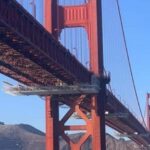
Stop 12: Golden Gate Bridge viewpoint from the US-101 off-ramp
This is one of the headline segments. Stop 12 is an US-101 off-ramp/Sausalito Lateral Rd stop, with the goal of Golden Gate Bridge views toward Marin County.
Even from the bus, this is where the tour pays you back for staying onboard. The bridge is the city’s signature. You’ll get broad views without needing to coordinate a separate trip.
Practical note: bridge photos depend on light and weather. If it’s foggy, you’ll still see the shape and angles, but you might not get the crispest horizon. If it’s clear, try to keep your camera ready when the bus slows or pulls into the stop area.
Stops 13 to 15: Golden Gate Park hits, from Japanese Tea Garden to Cal Academy
Golden Gate Park is where you’ll feel how big San Francisco is. The route includes several stops:
- Stop 13: Dr Inessa Sosis at the Golden Gate Park area (Fulton Street & 8th Avenue)
- Stop 14: de Young / Tea Garden for the Japanese Tea Garden, DeYoung Museum, and JFK Drive
- Stop 15: Cal Academy at the Music Concourse and California Academy of Science
This is where you should pick your priorities. Golden Gate Park can swallow half a day if you let it. The tour gives you multiple entry points so you can choose a style of visit:
If you like gardens and calmer walking, aim for the Japanese Tea Garden area. If you want museums and architecture, DeYoung and the surrounding district are logical targets. If science is your focus, the California Academy of Science is the anchor at this stop cluster.
A practical rhythm works best here:
- Hop off for one main area
- Walk just enough to get your photos and feel of place
- Return to the bus and move on, instead of trying to cover everything
Stop 16: Haight-Ashbury at Haight St & Clayton St
After the park, the route shifts toward Haight-Ashbury at Haight St & Clayton St. This stop is your ticket into a different vibe: the SF that people come to recognize through music history and street culture.
From the bus, you’ll see how the neighborhood sits in relation to nearby hills and streets. If you hop off, it’s usually best for a short walk with a specific goal: a photo spot, a quick shop window, or just an easy street-level feel.
Don’t force a long wandering session here if your feet are tired. Between waterfront sights, downtown blocks, and park walking, your legs will appreciate a more targeted approach.
Stop 17: Alamo Square at Divisadero & Hayes
Next you reach Alamo Square near Divisadero St & Hayes St. This stop is great for a classic SF scene—this is the part of the tour where you’re likely thinking about postcards and skyline backdrops.
If you hop off here, I’d give yourself time for a slower look. The angle and the light can change quickly, and this is the sort of stop where you want at least a few minutes to frame photos without rushing.
Also, this is a nice “middle reset” before you head into the Civic Center area.
Stop 18: Civic Center near Larkin & McAllister
The final listed stop is Mcallister St & Larkin St in the Civic Center area. Finishing near Civic Center is a practical landing zone because it’s still within the city’s structured street network, so it’s easier to plan next steps.
Use this last stop as your planning moment. If you still have energy, you can walk toward nearby landmarks. If you’re done sightseeing for the day, you’re in a zone where it’s usually easier to connect onward.
This endpoint also helps you avoid the common mistake of burning your energy too early. By the time you reach Stop 18, you’ve already gotten the big-name SF highlights.
Live guide, audio app, and onboard Wi‑Fi: how to get more meaning from the ride
This tour leans on two listening modes: a live tour guide in English and an audio guide app with commentary in multiple languages.
The live guide is best for real-time guidance: where you should look out the window, what a stop is best for, and what you might want to see if you hop off. The audio app is your backup and your deepening tool, especially when the bus is moving and you want to follow along without missing cues.
Two practical details you’ll want to plan for:
- The audio guide app is available in many languages, including English, Spanish, French, German, Italian, Portuguese, Hindi, Japanese, Korean, Punjabi, Russian, Vietnamese, and Chinese.
- Headphones aren’t included, so you’ll need your own earphones and smartphone.
Also, free Wi‑Fi onboard can help you map your next hop or check timing if your group splits. It’s not magic, but it can reduce stress when you’re trying to meet back up.
One more comfort note: one rider described loud music and asked for volume to be lowered. If you’re noise-sensitive, keep your earphones ready early.
Value check: when this hop-on hop-off bus is a smart buy
Even without a stated price here, I can still tell you when this tour tends to deliver value.
It’s often worth it if:
- You want major sights plus flexibility in one outing
- You’re visiting for a short time and want a fast orientation route
- You like the option to hop off for one or two targeted walks rather than committing to a long guided tour
It may not be the best fit if:
- You want long, detailed storytelling at every stop
- You need a quiet ride where everything is perfectly calm and controlled
- You rely on mobility aids and need a smooth, easy boarding experience every time
Think of this tour as transportation plus highlights. If you use it like that, you’ll get your money’s worth through time saved.
Should you book this City Sightseeing San Francisco bus?
Book it if you want an efficient first look at San Francisco that covers Union Square, Chinatown, North Beach, Fisherman’s Wharf, Golden Gate Bridge views, Golden Gate Park, and Haight-Ashbury—without the effort of driving or parking. The combination of a live English guide, a multi-language audio app, and frequent buses every 40 minutes is a strong match for flexible sightseeing.
Skip it or reconsider if you’re expecting quiet narration and guaranteed comfort with mobility aids. If that’s your situation, I’d plan a more tailored day with smaller segments instead of committing to a full hop-on hop-off loop.
If you do book: pick one stop to linger at (Golden Gate Park is usually the best), one photo-focused stop (like the Lombard Street area or bridge viewpoint), and keep everything else as a “ride-through and decide later” moment. That strategy fits San Francisco perfectly.
FAQ
How long is the City Sightseeing San Francisco hop-on hop-off bus tour?
The tour duration is listed as approximately 2 hours.
How often do the buses depart?
Buses run every 40 minutes.
Where are the first and last departures, and what times are they?
The first departure is from Stop 1 at 10:15am, and the last departure is from Stop 1 at 5:30pm.
Is there a live guide and is it in English?
Yes. There is a fun and friendly live tour guide on all buses, and it’s offered in English.
Do I need to bring headphones for the audio guide app?
Yes. The audio guide app is available, but headphones are not included. Bring your own earphones and a smartphone.
Does the bus stop right next to Pier 39?
No. The buses do not stop right next to Pier 39. For Pier 39, hop off at Stop 6 (Pier 35) and walk approximately 100 metres.