REVIEW · SAN FRANCISCO
Food, History, and Resistance: A Self-Guided Audio Tour
Book on Viator →Operated by VoiceMap Audio Tours · Bookable on Viator
A quick look at the streets can tell a whole story. This self-guided Food, History and Resistance in Japantown audio tour turns Japantown from a lunch stop into a living timeline, using on-the-ground details and audio you can pause when something grabs your attention. I especially like the focused stops that go beyond ramen and sushi, and the way the narration ties everyday places to bigger moments. One possible drawback: it’s self-guided, so there’s no live person to ask questions when you want more context.
You can do it in about 50 minutes to 1 hour with English audio, and you get lifetime access to the tour plus offline audio, maps, and geodata in the VoiceMap app. It starts at Osakaya Restaurant on Post Street and finishes near Geary Boulevard, so you’re not stuck backtracking forever. Plan for a phone and headphones, because the tour app is included but a smartphone is not.
In This Review
- Key Highlights You’ll Actually Notice on the Route
- Why Japantown Stories Need More Than a Food Run
- Price and Time: What You’re Paying For (and What You Aren’t)
- Your Starting Point at Osakaya Restaurant (and Why It Helps)
- Stop 1: More Than Ramen and Sushi, the Neighborhood’s Hidden Stories
- Benkyodo: Manju as a Living Tradition (and a Rare One)
- Bop City on Fillmore Street: Jazz After Hours and Community Power
- How to Get the Best Experience: Pace, Pauses, and Phone Setup
- Who This Tour Suits Best (and Who Might Want Another Style)
- Should You Book It? My Honest Take
- FAQ
- How long is the tour?
- What does the tour cost?
- Is the tour available in English?
- Do I need Wi-Fi during the tour?
- What’s included in the price?
- Does the tour include food or drinks?
- Where does the tour start and end?
- Are service animals allowed?
- Is it refundable if I cancel?
Key Highlights You’ll Actually Notice on the Route
- Offline VoiceMap access means you can keep going even with iffy cell service.
- Benkyodo’s rare manju legacy connects food to cultural survival.
- Bop City on Fillmore Street brings jazz legends into the story of community power.
- WWII internment references (including Tanforan and Topaz, Utah) can make the stops hit harder.
- Perfectly flexible pacing lets you pause at the places you care about most.
Why Japantown Stories Need More Than a Food Run
Japantown is easy to treat like a checklist: one good bowl of ramen, a quick dessert, move on. This tour nudges you to slow down and look at the neighborhood like it has memory. The audio focuses on food and resistance side-by-side, which is a smart mix because it keeps history grounded in real storefronts and real streets.
I like that it doesn’t pretend the only story here is entertainment or shopping. It treats everyday traditions—like the making of manju—as part of how a community stays itself under pressure. And it doesn’t stop at feelings; it points you to physical places you can stand in front of, which is where the story becomes harder to brush off.
You can also read our reviews of more food & drink experiences in San Francisco



Price and Time: What You’re Paying For (and What You Aren’t)
At $11.99 per person, this is priced like a budget-friendly activity, not a formal guided tour with tickets and museum fees. That matters, because the tour itself is the product: VoiceMap app access, the audio track, and offline support. You’re not paying extra for food or entry charges, so you can spend your money your way—snack if you want, skip it if you don’t.
The duration—about 50 minutes to 1 hour—is another value win. It’s short enough to fit between other plans, but long enough for the audio to take you through multiple themes instead of one quick detour. The route is also set up as a start-to-finish walk, from Osakaya Restaurant to 1010 Geary Blvd, which helps it feel like an itinerary rather than a looping scavenger hunt.
Your Starting Point at Osakaya Restaurant (and Why It Helps)
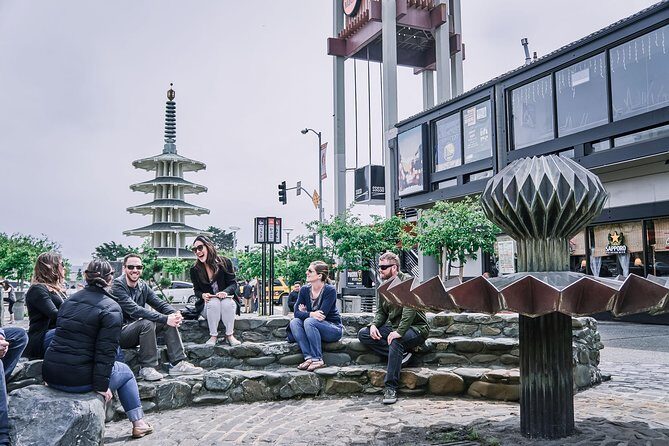
You begin at Osakaya Restaurant, 1737 Post St. Starting here is practical because it’s a known, easy-to-find anchor point in Japantown. When I’m using an audio app, I love routes that don’t make me guess where to begin or how to sync the track. With VoiceMap, you’re guided through the walk with maps and geodata so you can focus on listening instead of constantly checking your phone.
The tour is offered in English, and it’s designed so most people can participate. If you rely on public transit, you’re also in good shape since the start area is listed as near public transportation. And since the route is available essentially all day (the listed opening hours run 12:00 AM to 11:59 PM), you’re not forced into a narrow schedule.
Stop 1: More Than Ramen and Sushi, the Neighborhood’s Hidden Stories
The first stop sets the tone. It nudges you to see Japantown as more than a food corridor and explains that there are stories here many people miss. That’s not just marketing talk—this is the part where the audio frames how to listen to the rest of the walk. It makes you think about what’s been preserved, what’s changed, and what people carried with them even as the city shifted around them.
This is also where the narrative can feel personal. One of the most powerful notes from the experience is how the narration can connect to Japanese American internment history—references like Tanforan and Topaz, Utah show up through the storytelling approach. The audio also points you toward the idea of where people reported for internment, including mention of a gate next to the Japanese Language School. Even if your family history is different, the effect is similar: you realize you’re walking past places that matter, not just places that look nice.
Practical tip: when the audio gets serious, slow down on purpose. Let it play, then stand still for a minute after the speaker finishes. You’ll catch more, and you won’t feel rushed by the next stop.
Benkyodo: Manju as a Living Tradition (and a Rare One)
Benkyodo is the kind of stop you’re glad an audio tour includes. The story here is specific: Benkyodo is one of only three traditional Japanese manju makers remaining in the US, with the other two located in the remaining Japantowns of Los Angeles and San Jose. That detail turns a sweet into something larger—like you’re meeting a living craft, not just buying a dessert.
The audio explains what manju is and why it matters: traditionally filled with sweet bean paste and wrapped with mochi, a glutinous rice that’s pounded into a sticky, gooey mass. What I like about this kind of explanation is that it gives you a mental picture you can carry. When you hear the words while you’re standing near the maker’s presence, it makes the confection feel tied to technique and patience, not just taste.
A consideration: this stop is about heritage and place, not about tickets or museum-style access. If you’re expecting a formal demonstration or a timed tasting, the tour description doesn’t promise that. Still, even without extra entry fees, the storytelling makes the site feel important in a way you won’t get from a quick photo stop.
You can also read our reviews of more tours and experiences in San Francisco





Bop City on Fillmore Street: Jazz After Hours and Community Power
The final major stop zooms into music and resistance through the lens of nightlife. Bop City at 1712 Fillmore Street is described as a place to play after hours, where many notable jazz figures came through—John Coltrane, Billie Holiday, Miles Davis, and Duke Ellington. That list alone is a reason to listen closely, but the tour doesn’t treat it like trivia. It places the venue inside a larger pattern: in the 1940s, San Francisco’s Black community grew significantly, and Fillmore Street was dubbed the Harlem of the West.
That’s where the tour’s theme—food, history, and resistance—really clicks. Even if you’re mainly there for cultural discovery, this stop shows how art spaces can function as gathering points and identity anchors. When you hear those names while you’re standing at the location, it changes how you interpret the street. It becomes less about what you can see right now and more about what happened here when people needed community.
If you like history that connects to real culture—music, food traditions, and the everyday places communities build—this stop is likely to be the one you remember most.
How to Get the Best Experience: Pace, Pauses, and Phone Setup
This is a self-guided audio tour, and that’s a good thing—if you set it up like a tool, not a burden. Since the tour includes offline access to audio, maps, and geodata, you’ll want to plan one small step before you leave home: open the VoiceMap app while you still have a decent connection, so the needed content is ready offline.
During the walk, use the built-in pacing rather than trying to power through. Reviews for this type of tour often highlight that the flow works—there are moments where you can pause and look around more deeply instead of feeling dragged forward. I recommend you treat it like a guided conversation with breaks: listen first, then read the street second.
Also, bring a charged phone and headphones you actually like. The tour explicitly doesn’t include a smartphone, and audio tours rise or fall on whether you can hear comfortably.
Who This Tour Suits Best (and Who Might Want Another Style)
This tour is a strong match if you want cultural context without the cost and time overhead of a classic guided tour. It’s also a good fit for people who enjoy history tied to places you can walk up to—because the narration is built around specific stops you can find and stand near.
It may be less ideal if you want a lot of modern amenities on the route or a guided Q&A. Since it’s self-guided, you’re steering the experience. If you’re the type who needs constant clarification, you might prefer a live guide format.
The group size is listed with a maximum of 10 travelers, which suggests a structured experience rather than something chaotic. Even though it’s audio-based, that cap is reassuring if you prefer your outing to feel controlled and not overly crowded at the start or end.
Should You Book It? My Honest Take
If you’re looking for a low-cost way to understand Japantown beyond food, I think this is a smart booking. At $11.99 and about one hour, it gives you enough time to hit multiple themes—manju craft, jazz venues, and WWII-era history—without turning the day into a logistics project. The offline support is also a real practical benefit for San Francisco, where signal can be inconsistent.
I’d book it if you like stories that respect the neighborhood and don’t treat food as the only point. I might hesitate if you want a hands-on experience, guaranteed tastings, or a live guide to answer follow-ups. But if your goal is meaningful place-based understanding with flexible pacing, this one earns its keep.
FAQ
How long is the tour?
It takes about 50 minutes to 1 hour.
What does the tour cost?
It costs $11.99 per person.
Is the tour available in English?
Yes, it’s offered in English.
Do I need Wi-Fi during the tour?
No. The tour includes offline access to audio, maps, and geodata through the VoiceMap app.
What’s included in the price?
You get lifetime access to the Food, History and Resistance in Japantown tour, plus the VoiceMap application and offline access to the tour content.
Does the tour include food or drinks?
No. Food and drinks are not included.
Where does the tour start and end?
It starts at Osakaya Restaurant, 1737 Post St, San Francisco, CA 94115, and ends at 1010 Geary Blvd, San Francisco, CA 94109.
Are service animals allowed?
Yes, service animals are allowed.
Is it refundable if I cancel?
No. The experience is non-refundable and cannot be changed for any reason.