REVIEW · SAN FRANCISCO
San Francisco Self-Guided Audio Drive: Explore at Your Own Pace
Book on Viator →Operated by Adventures with Action · Bookable on Viator
A self-guided audio drive makes SF feel personal. I like how it turns long stretches of road into a story you can control, with hands-free audio that plays based on your location. It’s built for flexible pacing, so you’re not stuck waiting for a group to roll out.
I also like the value angle: one purchase covers the car, so $16.99 per person can become much cheaper once you’re splitting it inside one vehicle. And the content lasts—this tour comes with new lifetime access and works offline after you download it.
One thing to consider: you’ll need to follow the route closely, especially for the early turns. If you wander off track or get stuck in traffic, it can make the audio feel out of sync with what you see.
In This Review
- Key highlights you should care about
- Why a self-guided audio drive beats a fixed bus route
- Price and what you actually get for $16.99 per person
- Starting at Alamo Square: getting the Action app going right
- Hands-free audio in your car: the easiest way to listen
- The route flow: Painted Ladies to the Golden Gate View Point
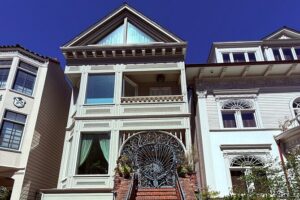
- Alamo Square and Painted Ladies: the color, the context, the why
- San Francisco City Hall: a marble landmark with origin stories
- Lombard Street and Telegraph Hill: short stops, big SF payoff
- Coit Tower and the housing story SF can’t ignore
- Chinatown by car: glass pyramid, murals, and optional walking time
- Dragon Gate and the cable car story
- Embarcadero, Ferry Building, Union Square, Fisherman’s Wharf
- Crissy Field and crossing the Golden Gate Bridge for the big finale
- SFMOMA and the tech story on the drive to the bridge
- Timing, traffic, and when the drive can slow down
- Common snags: GPS accuracy and finding the next stop
- Who should do this San Francisco audio drive
- Should you book this self-guided audio drive?
- FAQ
- How long does the San Francisco self-guided audio drive take?
- What language is the narration available in?
- Does it work offline?
- Where do I start and where does it end?
- Do I need tickets or a reservation for stops?
- Is there a guide with you during the tour?
Key highlights you should care about
- Lifetime access + offline playback: download once in good signal, then use it anytime on future trips
- Hands-free location triggers: audio starts for the next story when you reach each point
- 43+ audio stories over ~17 miles: a lot of narration for a half-day drive
- One purchase per vehicle: best for families and friend groups in one car
- Major SF hits in one loop: Painted Ladies, Chinatown, Embarcadero, Union Square, and the Golden Gate
- Short photo breaks built in: multiple stops are free to visit and timed for car-friendly exploring
Why a self-guided audio drive beats a fixed bus route
This is one of those SF experiences that works best when you’re honest about your style. If you like to stop for photos, linger at viewpoints, or duck out of the car when something grabs your attention, a self-guided audio drive fits you like a glove.
The main perk is control. You can start when you want, pause whenever you want, and keep going later. That’s a big deal in San Francisco, where weather can change fast and traffic can mess up “scheduled” sightseeing.
You also get to spend less time in transit between big sights. With a 3–4 hour flow and about 43+ stories, the narration keeps the drive from feeling like just sitting in traffic.
You can also read our reviews of more guided tours in San Francisco



Price and what you actually get for $16.99 per person
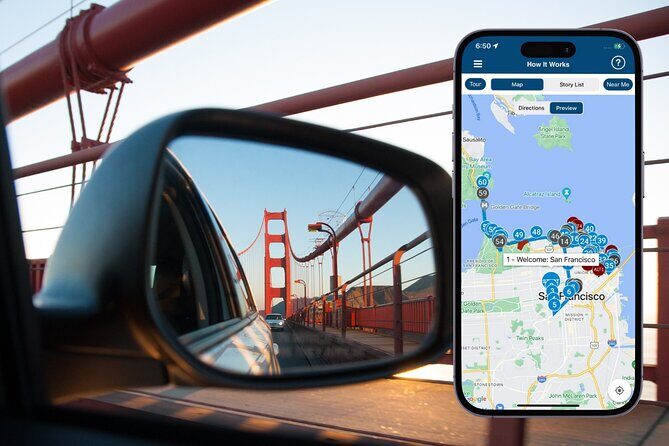
On paper, $16.99 per person sounds simple. The real value is that you pay for the tour per car, not per individual. If you’re traveling with a spouse, kids, or friends in one vehicle, that pricing structure can beat a hop-on hop-off bus in both flexibility and cost.
What you’re buying is not attraction entry. The tour includes the audio stories, route, and offline maps, but not tickets or reservations. That matters because several stops are free, like Lombard Street and viewpoints, while places like museums may still be your choice if you want to go inside.
Think of it as a guided drive without the guide. You’re covering a lot—more than 17 miles—and learning along the way, which is how you squeeze maximum payoff out of limited vacation time.
Starting at Alamo Square: getting the Action app going right
Your start point is Steiner Street at Alamo Square Park. No one meets you there. You’ll simply find the first story location, launch the tour in the app, and let the audio cue the next stop.
Setup is the part that’s easy to rush, so don’t. After booking, you get an email and a text with a password and instructions. You’ll need to download the separate Action’s Tour Guide App and enter that password. The key rule: you must download the tour while you’re on strong wifi or cellular. After that, it’s set up to work offline.
On the day you ride, open the Action audio tour app once you’re onsite. If the app offers multiple versions, choose the one that matches your planned starting point and direction. Then you’re good to go.
Hands-free audio in your car: the easiest way to listen

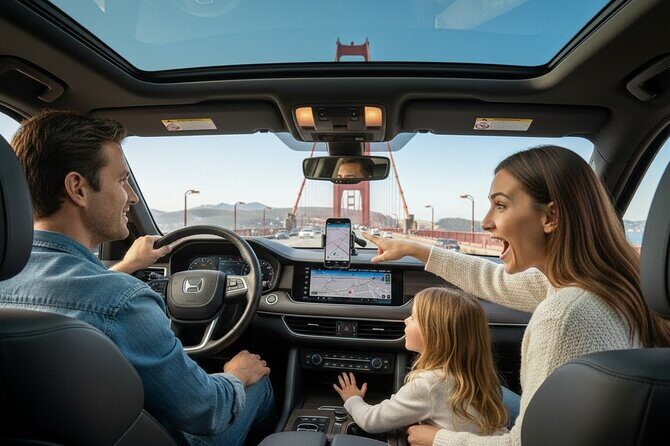
The tour is designed to play hands-free based on where you are. Once you have the app running, the audio should trigger as you reach each story point, so you’re not staring at your phone the whole time.
For sound, you have options: connect your phone to your car stereo using Bluetooth, USB, or AUX. If you’re trying to use CarPlay or similar features, the tour notes Apple CarPlay compatibility, and it says Android Auto support is on the way. In practice, the safest setup is usually the basic stereo connection methods.
If you plan to do any walking—like the optional explore time in Chinatown—you might also prefer your phone speakers or headphones, depending on how your car setup works. The tour is flexible. You’re the one driving.
The route flow: Painted Ladies to the Golden Gate View Point

This drive is mapped as a loop that links famous SF neighborhoods with major landmarks. The itinerary is long enough to feel like a real “day of sights,” but it’s broken into short, manageable stops that fit a car-based itinerary.
Plan for 3–4 hours total for the main loop. If you stop for extra photos or short walks, you’ll go longer. The good news: the app lets you pause freely, so you’re not trapped in someone else’s schedule.
Here’s how the experience feels as you move from one story location to the next.
You can also read our reviews of more tours and experiences in San Francisco



Alamo Square and Painted Ladies: the color, the context, the why
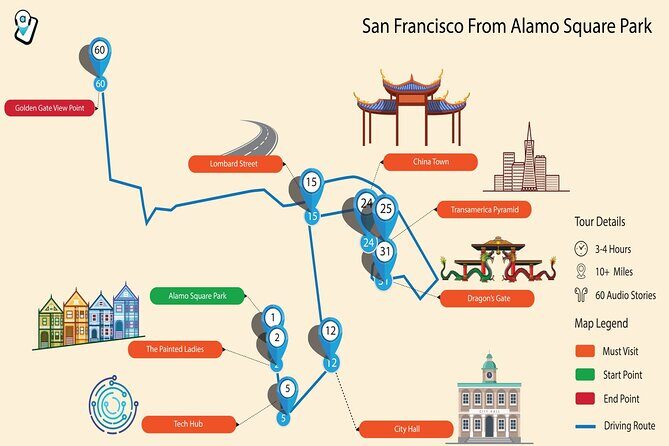
You begin at Alamo Square, then pass by the Painted Ladies—those famous Victorian houses that people photograph again and again. What makes this stop work on an audio tour isn’t just seeing the view. It’s understanding how they got their vivid color and what that says about SF’s changing identity.
As you drive onward, the narration frames SF as a place with a past, a present, and a future. That’s useful because the city can feel like it’s made of different worlds that don’t talk to each other—Victorians over here, tech over there, and cliffs between. The audio ties it together so your brain doesn’t have to.
If you’re arriving early, or you want a quick “warm-up,” this part does the job.
San Francisco City Hall: a marble landmark with origin stories
Next up is San Francisco City Hall, a big marble building you can spot from the road even when you’re not looking for it. The audio story focuses on how the city was founded and why it grew.
I like this kind of stop early in the tour. When you get context early, later neighborhoods make more sense. You’re less likely to treat Chinatown, the Embarcadero, or the waterfront as random stops.
Drawback to note: you’ll mostly be experiencing this from your car while passing. If you want to linger on the building itself, you’ll need to find a safe, legal place to stop.
Lombard Street and Telegraph Hill: short stops, big SF payoff

Lombard Street is the one-block wonder with the famous hairpin turns—the one locals love to point out and visitors can’t stop filming. The audio cues you to be careful and to expect the tightly winding stretch.
It’s timed as a quick visit (about 10 minutes). That’s perfect because even if you want photos, you don’t need long. Just be patient and drive like you mean it. One hairpin too fast turns your sightseeing into stress.
Then you head to Telegraph Hill for a strong view of the bay and city skyline once you’re up there. Again, it’s set up for a short break, and you’ll get the kind of perspective that makes SF feel bigger than its neighborhoods.
Coit Tower and the housing story SF can’t ignore
After Telegraph Hill, the tour climbs to the top area of Coit Tower. The payoff here is the classic SF vantage point—views that make the hills, the water, and the city grid feel connected.
The narration then shifts gears into a topic SF is dealing with: rapid real estate growth and the housing crisis. That kind of story fits well here because Coit Tower is literally on a high spot where you can see how development patterns stretch across the city.
If you dislike heavy topics while sightseeing, you might want to mentally prepare for this shift. It’s not a bad add-on—it just changes the mood.
Chinatown by car: glass pyramid, murals, and optional walking time
This is one of the most rewarding segments because Chinatown isn’t presented as one stop. It’s treated like a moving timeline as you pass landmarks and switch stories at key points.
As you approach, you’ll see a huge glass pyramid and hear about its strange history as you drive by. Then the tour points out two iconic symbols: the Chinatown Mural and the Old Chinese Telephone Exchange.
What I like: the audio doesn’t just name things. It ties them to Chinese and Asian immigrants’ impact on San Francisco, so you understand why these places matter, not just what they look like.
There’s also an optional moment where you can jump out for a walk through Chinatown for foods, drinks, and desserts. The tour is still car-based, but it gives you permission to slow down and actually experience the streets.
Practical note: Chinatown can mean tight driving and lots happening at ground level, so keep your phone/parking situation simple.
Dragon Gate and the cable car story
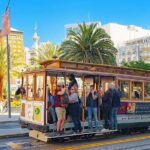
As you exit Chinatown through the Dragon’s Gate, the audio pivots to another SF signature: the cable car. You’ll drive through the south-facing gate at Bush Street and Grant Avenue, then learn how the cable car became the kind of symbol SF proudly shows off.
I like this transition because it keeps you thinking like a local: “What is this city’s identity, and why does it survive?”
This segment is also a nice mental break before you head toward the waterfront and maritime stories.
Embarcadero, Ferry Building, Union Square, Fisherman’s Wharf
Once you move toward the waterfront, the tour leans into San Francisco’s maritime history and its gold-digging past. The audio narration brings you to the Embarcadero, setting up an easy day structure: history along the water, then landmark after landmark.
From there, the tour reaches the Ferry Building. You’re guided with the story of Golden Gate Bridge—why it nearly didn’t exist—while you follow the waterfront route. The tour suggests an “iconic trip” over the Golden Gate Bridge via Ferry Building or Fisherman’s Wharf, but the audio is what keeps you informed while you’re driving.
Next comes Union Square, described as a center for art, theater, and shopping around the Dewey Monument. You’ll also get a quick sense of the cultural mix in the area and what makes it a longstanding focal point in SF.
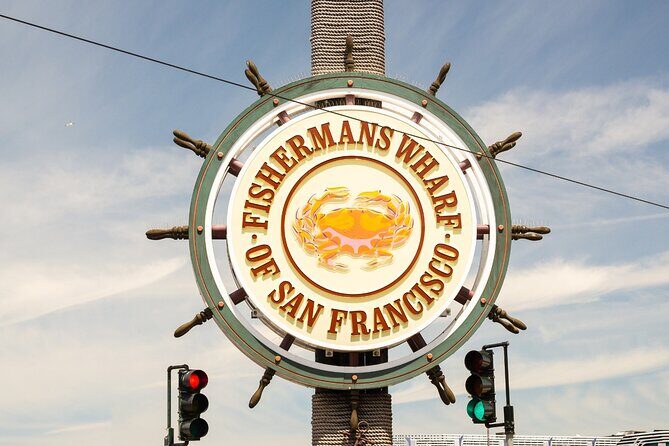
Then you hit Fisherman’s Wharf, where the audio focuses on how the Golden Gate Bridge overcame construction and engineering problems, including money and aesthetic issues. It’s an unusually specific way to look at a bridge people usually just take for granted.
If you only have time to “see the bridge,” this section gives you enough background to appreciate the structure as real engineering, not just a postcard.
Crissy Field and crossing the Golden Gate Bridge for the big finale
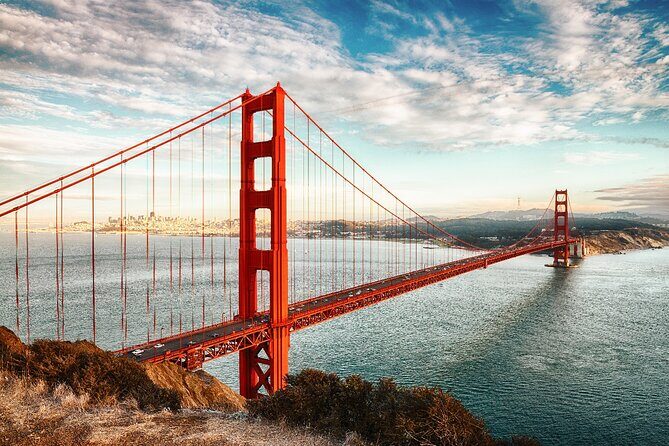
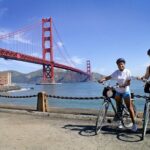
At Crissy Field, the tour builds in a view break so you can take in the Golden Gate Bridge. The story explains why it’s red and why its opening week was a major moment, then connects the bridge to its modern role in transportation.
Then it’s time to cross. You’ll pass the Golden Gate Welcome Center along the way, and the audio continues the construction story. There’s also a note on why the bridge is a favorite set piece for Hollywood—SF has a sense of humor about that, and it helps the narration feel less like a lecture.
Finally, the tour ends at the Golden Gate View Point on the far side. It’s a great finish because it rewards you with a real sense of arrival: you’ve driven the city’s major story arc and end with the skyline-and-water combo.
SFMOMA and the tech story on the drive to the bridge
Two more “modern SF” stops show up in the latter part of the tour.
First, there’s mention of San Francisco Museum of Modern Art (SFMOMA), including that it’s a nonprofit with an internationally recognized modern and contemporary collection. The tour notes it was the first museum on the West Coast devoted solely to 20th-century art.
Then the narration pivots to technology. San Francisco is presented as a tech hub tied to Silicon Valley, and the story points to upcoming headquarters for Uber and Twitter as examples of that relationship.
I like this because it keeps the drive from becoming only history. SF is both old and new, and the audio does a decent job of reminding you that the city’s identity keeps shifting.
Timing, traffic, and when the drive can slow down
A drive tour is only as smooth as your traffic. One of the practical lessons from the tour format is this: if you hit rush hour, your planned stop timings won’t hold.
If you want the cleanest experience, pick a time when you’re less likely to sit for long stretches. And while the audio is location-based, delays can make it feel like you missed cues—especially early in the route—so build in some buffer time.
Also, remember the tour is set around car movement and short stops. Many stops are free to view, but you still need to follow safe driving and speed rules.
Common snags: GPS accuracy and finding the next stop
The biggest “watch out” isn’t the audio. It’s navigation behavior.
The tour guidance says you should stick to the tour route & speed limit for the best experience. When people take a wrong turn or veer off the set path, the app may not reflect what you expect to see next, and you can end up hunting for the story point.
There’s also the practical reality of car screens. If your car display or audio setup doesn’t play nicely with your phone connection, you can fall back to your phone’s speaker system. And if audio doesn’t trigger, the tour support option is there, but you’ll have a better time if you keep your phone stable and your connection consistent.
At the start, pay attention to how you’re approaching. If you enter the area from a different direction than you expected, it can add confusion for the first few story triggers.
Who should do this San Francisco audio drive
This tour is a strong fit if you want:
- Flexibility instead of a bus schedule
- A car-based way to hit major sights efficiently
- A detailed introduction to neighborhoods like Chinatown and areas like the Embarcadero
- A fun day for groups who can stay together in one vehicle
It also works for families, because you can pause, take snacks, and keep everyone moving. If kids get restless, the short stop rhythm helps. If your group is split—someone wants photos, someone wants viewpoints—you can still keep the tour flowing.
It may not be ideal if you hate driving through city streets or you can’t reliably play audio from your phone.
Should you book this self-guided audio drive?
Book it if you want a San Francisco day that feels structured without feeling rigid. The big win is the combination of hands-free audio, offline maps, and lifetime access you can reuse on future trips. For a city where distances add up, the value-per-car setup is also hard to ignore.
Skip it if you’re only looking for one or two landmarks and don’t want to drive a long 17-mile loop. And if you already know you struggle with following a set route, the audio experience depends on you staying close to the story points.
If you want an easy way to turn a car ride into real city understanding, this one is a solid choice.
FAQ
How long does the San Francisco self-guided audio drive take?
The tour takes about 3–4 hours to complete and covers an overall route of over 17 miles.
What language is the narration available in?
The tour is offered in English.
Does it work offline?
Yes. You download the tour while you have strong wifi/cellular, and it then works offline with offline maps.
Where do I start and where does it end?
You start at Steiner Street at Alamo Square Park (Steiner St, San Francisco, CA 94117) and the tour ends at the Golden Gate Bridge area at Golden Gate Brg, California.
Do I need tickets or a reservation for stops?
No. The tour includes audio and the route, but it does not include attraction passes, entry tickets, or reservations.
Is there a guide with you during the tour?
No. This is self-guided, and there’s no in-person guide.