REVIEW · SAN FRANCISCO
Self-Guided Audio Tour of the Golden Gate Bridge
Book on Viator →Operated by VoiceMap Audio Tours · Bookable on Viator
Golden Gate Bridge feels huge when you have the right guide. This self-guided audio tour uses GPS so you hear stories at the exact spots, from the Welcome Center to the viewpoints, without needing to match a group pace.
I especially like the clear narration that points out what you are looking at, and I also like the built-in structure of stops that makes the walk feel purposeful instead of random.
The second thing I like is the flexibility. You can follow the route in the app at any time during your booking day, and you can start, pause, and pick it up later from a different spot. That matters in San Francisco, where fog and weather can mess with your original plan.
One possible drawback: you need your own smartphone and headphones. Also, since the tour includes walking across the bridge and ending at a different point (Sausalito-side vista), it is best if you are comfortable with a one-way end location and some walking.
In This Review
- Key highlights you’ll feel on the walk
- Why this Golden Gate Bridge audio route works so well
- Golden Gate Bridge Welcome Center: start with the bridge’s design story
- The main cable cross-section: where the “why” becomes visible
- Walking the bridge: the Great Depression era and two key names
- Vista Point for sweeping views (and a good reset)
- H. Dana Bowers Memorial Vista Point: the skyline wrap-up
- Price and value: is $7.99 a good deal?
- App and audio tips: getting the most from GPS guidance
- Who should book this Golden Gate Bridge audio tour?
- Should you book it?
- FAQ
- How long does the Golden Gate Bridge self-guided audio tour take?
- How much does it cost?
- Where does the tour start and end?
- What language is the audio in?
- Do I need headphones or a smartphone?
- Does it work offline?
- Can I cancel and get a refund?
- Is it a private experience?
Key highlights you’ll feel on the walk
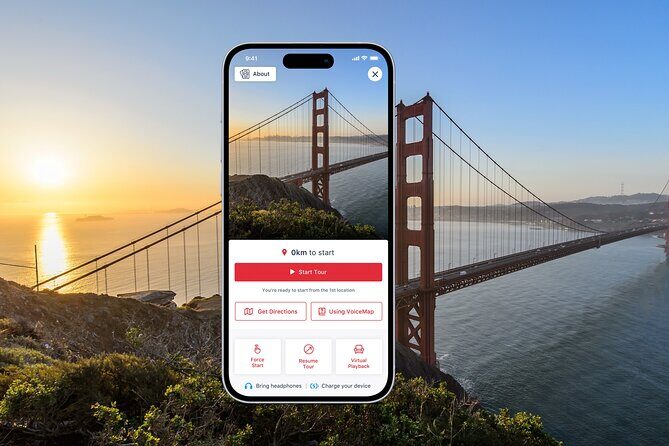
- GPS-guided audio timing that tells you what to look for right when you reach each stop
- Offline access to audio, maps, and geodata, handy when reception is spotty
- Engineering focus: suspension system basics and a main-cable cross-section view
- Historical context tied to Joseph Strauss and Irving Morrow and the Great Depression era
- Two major viewpoints to close the experience with sweeping bridge-and-city views
- Flexible use: you can take it at any time on your booking day and resume later
Why this Golden Gate Bridge audio route works so well
A lot of Golden Gate Bridge visits feel like this: you look, you take photos, you wander, and you hope the important story is somewhere in your brain. This tour fixes that by tying audio to place. As you move, the narration keeps catching up to what you are seeing.
It also helps that the route is short enough to fit into a normal day. You are typically looking at about 1 to 1.5 hours, which is a sweet spot: long enough to learn the big ideas, short enough that you are not drained if the wind picks up.
And because it is self-guided, you can linger. Some days the bridge is sunny and dramatic. Other days it is gray and moody. Either way, you can slow down at the good photo points without feeling like you are holding anyone up.
You can also read our reviews of more guided tours in San Francisco


Golden Gate Bridge Welcome Center: start with the bridge’s design story
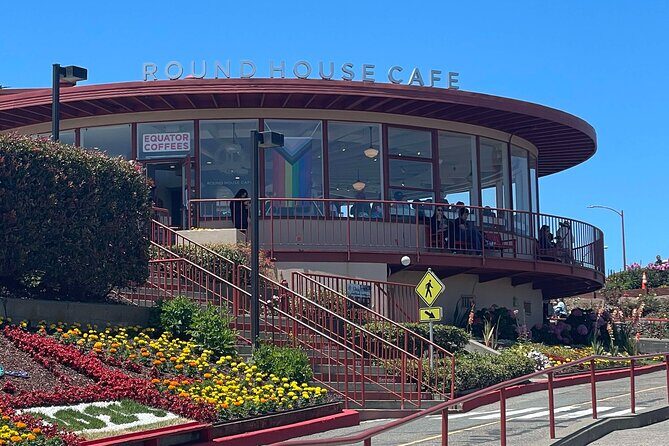
You begin at the Golden Gate Bridge Welcome Center at Golden Gate Bridge Plaza (San Francisco, CA 94129). This is a smart starting move because it gives you the “how it works” side before you walk the “wow it looks” side.
At this first stop, the audio focuses on the bridge’s innovative suspension design and the way the suspension system supports the span. You’ll get a feel for why this structure has the strength and flexibility it needs to handle real-world stress—wind, movement, and the general chaos of coastal weather.
What I like here is the pacing. Instead of throwing dates at you right away, you learn the basic mechanics first. Then, when you step onto the bridge, your eyes naturally start scanning cables and structure. It turns the walk into a guided observation, not just sightseeing.
A small consideration: if you arrive super late or super early, you’ll still want to be mindful of the bridge area hours listed for the experience window—5:00 AM to 6:30 PM during the stated operating range (dates shown on the experience details). Plan to be there with enough daylight for comfortable photos.
The main cable cross-section: where the “why” becomes visible
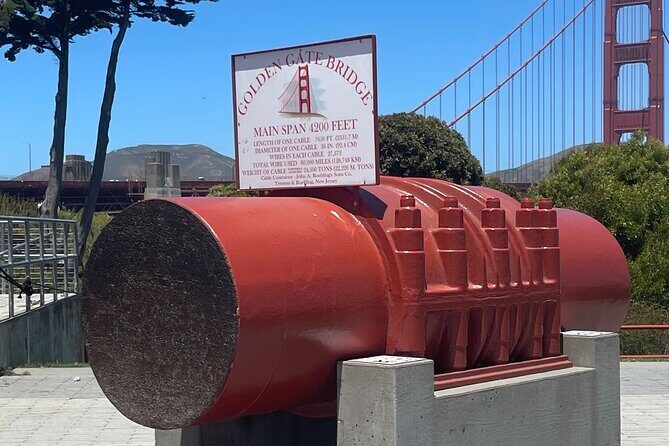
Next, you look at a cross-section view of the Golden Gate Bridge’s main cable. This part is so useful because it turns an abstract engineering concept into something you can literally see as layers of steel wires.
Even if you do not care about engineering normally, this stop helps you understand what you’re walking over. Suspension bridges depend on cables and the way forces are distributed through them. When the tour points out the cable’s structure, your brain starts reading the bridge correctly.
Practical tip: take a moment to slow down and look from more than one angle. A cross-section display can make you think you’re seeing everything at once, but a couple of small shifts in position can help you spot details the first glance misses.
Walking the bridge: the Great Depression era and two key names

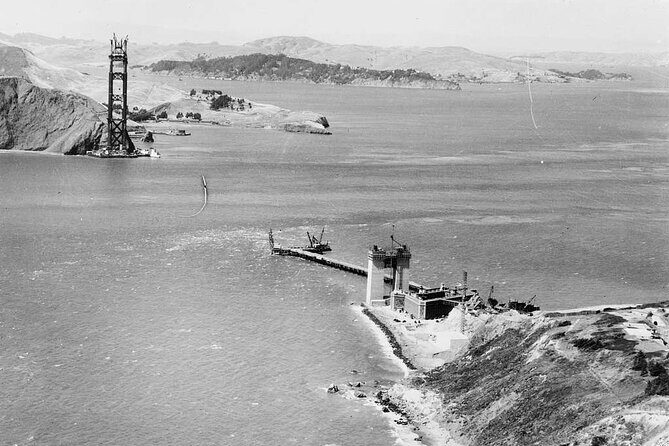
Now comes the big one: you walk across the Golden Gate Bridge while the audio explains construction and key contributors. This is where the experience gains personality.
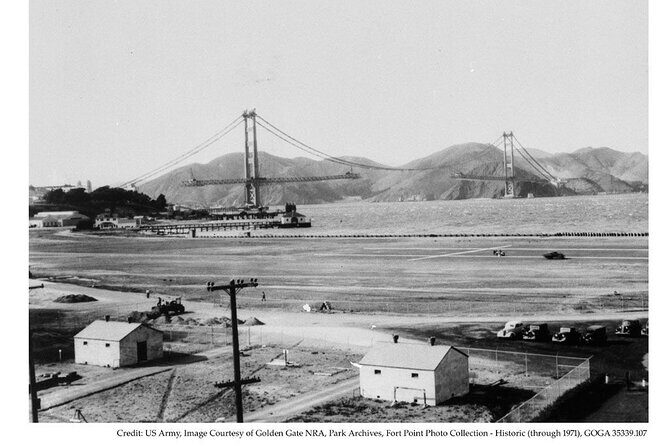
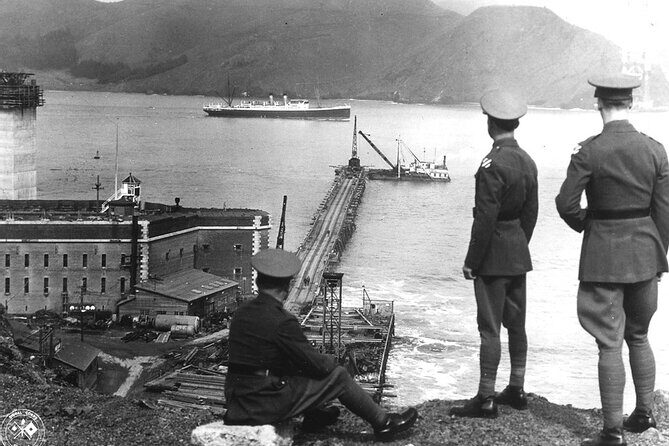
You’ll hear about how the bridge was built during the Great Depression, and you’ll also get the spotlight on design contributions by Joseph Strauss and Irving Morrow. That helps turn the bridge from a postcard into a human project with ambition and collaboration—and it gives context to why the completion became something to celebrate.
Here’s what this does for your experience: it gives your feet something to do besides march. When you know the bridge is connected to names and a specific era, the scenery feels less like background and more like a story unfolding in front of you.
Consideration while walking: the Golden Gate can be windy, and this tour is still fundamentally a walk. If you are sensitive to crowds or long distances, you may prefer to go earlier in the day for calmer conditions. The tour’s flexibility means you do not have to force the visit into a specific time slot once you are booked.
Vista Point for sweeping views (and a good reset)
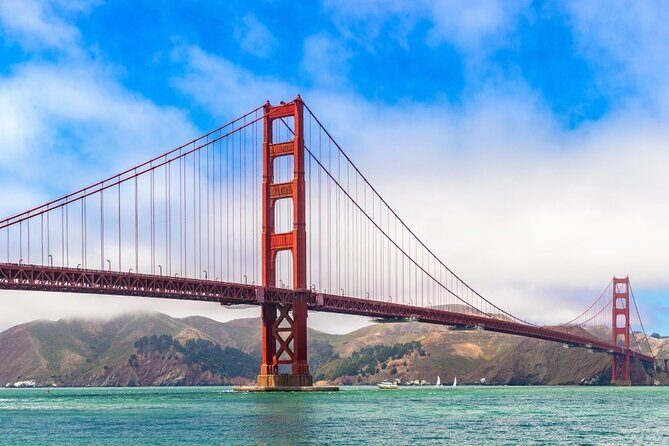
After the main bridge crossing, you reach the Vista Point. This is your moment to take everything you learned and wrap it in what you came for: the view.
The narration here focuses on the grandeur of the bridge and its relationship to the modern San Francisco area you can see around it. Vista Point is a great place to pause because it gives you a clear sightline that makes the bridge look even more structural—like it is engineered to frame the city, not just connect two sides.
What I suggest: treat Vista Point as your reset stop. Look outward first (bridge-to-city relationship), then look back (bridge geometry and cable lines). Doing both helps you absorb more than just the iconic shot.
You can also read our reviews of more tours and experiences in San Francisco





H. Dana Bowers Memorial Vista Point: the skyline wrap-up
Your tour ends at the H. Dana Bowers Memorial Vista Point on Redwood Hwy in Sausalito (CA 94965). The big reward is panoramic scenery—San Francisco’s skyline and surrounding landmarks beyond it.
This ending stop also ties the city’s evolution into what you’re seeing now. You’ll hear about the impact of the 1906 earthquake and how that shaped San Francisco’s story from the Gold Rush era onward.
The end location is important: it is not a loop back to your starting point. Your route finishes on the other side of the bridge. That can be great if you are continuing your day in Sausalito or nearby areas. If you planned to return immediately to downtown, you’ll want to think about transportation ahead of time.
Also, bring the practical mindset: this is a viewpoint. Spend a little time, yes, but don’t stay so long that you freeze. Your app audio keeps you on track, but you are still at the mercy of wind and time.
Price and value: is $7.99 a good deal?
At $7.99 per person, this is priced like a low-friction add-on to a major attraction. You’re not paying for a guide’s labor in the classic sense. You’re paying for a well-structured route with audio tied to location.
Here is why that price can feel fair:
- The bridge walk is already the “activity.” The audio turns that walk into a learning experience without adding another tour group to coordinate.
- You get lifetime access before and after booking dates, so you can revisit the route later if you want.
- You get offline audio, maps, and geodata, which reduces stress on tech during outdoor walking.
Where value depends on you:
- If you already know the bridge story and mostly want photos, you might not feel the benefit.
- If you enjoy guided context—engineering basics, the Strauss and Morrow names, and the Great Depression timeline—this will likely feel like a smart use of your time.
My take: at this price, it is an easy yes if you like structured storytelling while you walk. It’s less compelling if you want a purely visual visit with no narration.
App and audio tips: getting the most from GPS guidance
This is a GPS self-guided experience, with an app for Android and iOS. It also includes offline access to audio, maps, and geodata, so you can plan without relying on constant cellular coverage.
Here’s how to make it work smoothly:
- Bring your smartphone and headphones before you arrive. The tour does not provide them.
- Download everything early if your phone allows it, so you do not start the walk worrying about signal.
- Keep your screen brightness reasonable. Wind and glare can make GPS and buttons harder to use.
- When you stop to look around, let the audio finish its point. Then move. That rhythm helps you learn instead of rushing.
One more practical note from real-world usage: if something goes wrong with getting your tour access information, the provider’s support contact is available by email at [email protected]. I’d treat that as a basic safety net—because a tour like this only works when your app is ready before you’re out on the bridge.
Who should book this Golden Gate Bridge audio tour?
This experience fits best if you want:
- a self-paced Golden Gate Bridge visit without joining a large group
- a structured route with narration at each meaningful spot
- a short learning experience that can fit around other San Francisco plans
It is also a good option for families, since the narration style is described as engaging even for kids. And because the experience is private to your group (no mixing with strangers), it can feel calmer.
What might not fit as well:
- If you dislike walking or you need a fully round-trip route back to the start, the one-way ending at H. Dana Bowers Memorial Vista Point could be a mismatch.
- If you do not want to manage your phone and headphones, you’ll probably be happier with a tour style that includes gear.
Should you book it?
I think this is a strong buy for the right visitor. If you like walking and you want your Golden Gate Bridge visit to come with clear explanations—suspension basics, the main cable structure, plus the Strauss and Morrow story—this tour is an efficient way to upgrade your experience without adding cost or complexity.
Book it if you are the type who takes in details when you have a plan. Pass if you only want quick photos and you do not care about engineering or historical context.
FAQ
How long does the Golden Gate Bridge self-guided audio tour take?
It is listed as about 1 hour to 1 hour 30 minutes.
How much does it cost?
The price is $7.99 per person.
Where does the tour start and end?
It starts at the Golden Gate Bridge Welcome Center at Golden Gate Bridge Plaza, San Francisco, CA 94129. It ends at the H. Dana Bowers Memorial Vista Point on Redwood Hwy, Sausalito, CA 94965.
What language is the audio in?
The tour is offered in English.
Do I need headphones or a smartphone?
Yes. Smartphone and headphones are not included, but the tour works through the app.
Does it work offline?
Yes. It includes offline access to audio, maps, and geodata.
Can I cancel and get a refund?
Yes. You can cancel for a full refund up to 24 hours in advance. After that point, no refund is listed.
Is it a private experience?
Yes. It is described as private, meaning only your group participates.